
Building Bankable Agribusiness in Sub-Saharan Africa

A new economic boom is taking root in Africa’s soil. As investors look beyond traditional markets, the continent’s vast agricultural potential is emerging as a powerful engine for trade, jobs, and food security. What is unfolding is more than a farming story — it is a transformation of land, capital, and opportunity taking root across Sub-Saharan Africa (SSA).
This moment marks an inflection point for agricultural modernization across the continent. The Sub-Saharan region holds 60% of the world’s uncultivated arable land from Nigeria to the fertile land across the East African Rift Valley, yet only a fraction is currently farmed. Driven by easing inflation and a modest recovery in investment, rapid urbanization and income growth are creating new demand for diversified food products — from high-value fruits and vegetables to animal protein — both within Africa and across export markets. As this transformation gathers momentum, agriculture remains the backbone of many African economies, employing 70–80% of rural workers and contributing up to 30% of GDP in several countries, according to the Food and Agriculture Organization’s FAOSTAT database. With the African Continental Free Trade Area (AfCFTA) and various bilateral trade deals reducing tariffs and integrating regional markets, the continent is increasingly positioned to compete on the global agri-food stage.
However, turning potential into profit requires more than fertile land and favorable demographics. Africa’s agribusiness sector must attract investment through well-structured deals, robust legal and institutional frameworks, and high operational standards that meet international requirements. At the same time, market access strategies — from compliance with global food-safety standards to efficient logistics — are essential for scaling exports sustainably. This article explores how these building blocks come together to create profitable, export-ready agribusiness ventures in Sub-Saharan Africa. It examines the policies, financing mechanisms, and operational practices driving success stories across the continent — from Ghana’s cocoa governance and Nigeria’s farmer cooperatives to Zambia’s food-safety systems and Kenya’s logistics innovations, — themes that will be explored in greater detail throughout the article. Together, these examples reveal how the right mix of capital, compliance, and capacity can turn Africa’s agricultural promise into a global powerhouse — transforming opportunity into lasting prosperity across the continent.

Legal and Institutional Frameworks
Across Sub-Saharan Africa, governments are no longer passive rule-makers — they are building active institutions that make export agriculture investible. Ghana’s Cocoa Board does far more than set prices: it stabilizes farmer incomes, enforces quality standards, and channels export marketing. Ethiopia’s Export Trade Enterprise coordinates export licensing, market linkages and bulk shipments for key commodities such as raw coffee — Ethiopia’s largest export crop, smoothing the path to buyers abroad. And investment one-stops like the
Tanzania Investment Centre and the Ethiopian Investment Commission offer permit facilitation, incentives and investor protection — practical tools that turn legal clarity into faster deal execution and real capital flows. Equally important, policies on land tenure, labor rights, and phytosanitary standards must be transparent and properly enforced. Standards institutions like the Zambia Standards Authority ensure compliance and quality control across value chains. Collectively, these measures strengthen investor confidence and traceability in agricultural trade. These institutional reforms are setting the stage for more innovative investment models on the ground. Also, investors often structure deals as joint ventures or cooperatives with local partners, ensuring alignment with national goals. Models like contract farming — where a buyer agrees to purchase output at set quality and price levels — are widely used and considered a best practice for export reliability. A successful example is Frutos da Lagoa in Angola, which integrates small fish farmers by supplying fingerlings (young fish used to stock ponds), feed, and training, then buying back their harvest — a PPP-style model (public-private partnership) that creates a win-win-win for farmers, financiers, and processors. Strengthening producer organizations and cooperatives can also lock in supply. Nigeria’s Babban Gona franchise model provides smallholders with inputs, training, and credit, plus a guaranteed market price — helping them double their incomes. Building on these partnership models, investors are also adopting more sophisticated financial and legal structures to manage scale and risk. Beyond cooperatives, Special Purpose Vehicles (SPVs) are increasingly popular among cross-border investors. Setting up SPVs in stable jurisdictions such as Mauritius or Rwanda allows investors to isolate project risks, protect capital, and facilitate easier co-investment with development institutions. These structures also simplify tax and profit repatriation, while offering governance aligned with international standards.
Financial Deal Structures
On the financing front, agribusiness projects often rely on blended finance, which combines public and private funding to make investments less risky. A good example is the Africa Agriculture & Trade Investment Fund (AATIF), supported by European development institutions such as the German Development Bank (KfW) and Deutsche Bank. The fund also includes a first-loss guarantee provided by the German Federal Ministry for Economic Cooperation and Development (BMZ), meaning that if a project fails, the public partners absorb the first losses. This arrangement lowers risk for private investors and encourages them to finance farms, processing companies, and agricultural cooperatives that might otherwise struggle to access credit. Such blended-finance structures have become an essential tool for linking private capital with development goals.
Building on this foundation, export-oriented agribusinesses can also use export credit and trade finance tools to access global markets more effectively. These mechanisms help companies manage the risks of selling abroad, such as delayed payments or currency fluctuations, while ensuring they have enough cash flow to fulfill international orders. For example, Nigeria’s Export Expansion Grant gives exporters a cash reward based on verified export performance — helping agricultural producers scale or invest in processing, while the European Union’s export credit insurance programs protect firms against non-payment from foreign buyers. Similarly, the African Export-Import Bank (Afreximbank) supports agribusiness exporters with pre-shipment financing, factoring services, and working-capital facilities tailored to their production cycles. Together, these tools help small and medium-sized agribusinesses scale beyond domestic markets, integrate into global supply chains, and attract foreign investment by demonstrating financial stability and export readiness. Political-risk insurance from institutions such as the Multilateral Investment Guarantee Agency (MIGA) or the African Development Bank (AfDB) can make cross-border agribusiness projects more bankable by protecting investors against losses from political instability, currency restrictions, or contract breaches. Beyond risk coverage, these agencies often lend credibility to projects, signaling stability and governance standards that attract additional private financiers. Moreover, as these financial and risk-mitigation mechanisms mature, they are increasingly converging with the global movement toward sustainable and impact-driven investment. Institutions such as the International Finance Corporation (IFC) and the Global Impact Investing Network (GIIN) are promoting common ESG standards so investors can assess both financial returns and social outcomes. As these frameworks gain traction, agribusiness projects that integrate carbon tracking and inclusive employment will stand out. The next phase of financing will reward ventures that link profitability with purpose — strengthening food systems while advancing long-term environmental and community resilience.
Operational and Production Best Practices
As financial frameworks take hold, the next challenge lies in execution — where operational excellence turns capital into tangible results. In Tanzania’s Kapunga Rice Project, led by Export Trading Group (ETG), productivity increased dramatically — from around 700 kilograms per hectare to roughly 7 tons per hectare — after farmers received improved seeds, better fertilizer, and targeted technical training. According to Business Beat 24, the project shows how practical interventions and farmer education can multiply yields and raise incomes, demonstrating that efficiency and knowledge transfer are as vital as financing in transforming agricultural value chains. Technology and monitoring are also transforming African agribusiness. Startups like Agrix Tech in Cameroon use AI-powered platforms to diagnose crop diseases from images uploaded by farmers, assisting smallholders in protecting yields and maintaining export quality. Agrix Tech’s app uses text and voice recognition in African local languages, providing high accuracy in disease detection and tailored recommendations, thus reducing the reliance on harmful pesticide use and increasing productivity. The startup remains active today, continuing to expand its reach and refine its technology to support more farmers across the region.
Building on these operational and technological gains, aligning with international quality benchmarks transforms raw commodities into trusted, premium products. In Zambia, Zambeef Products Plc maintains ISO 9001, 22000, and 14000 certifications across its plants and abattoirs — covering quality management, food safety, and environmental performance. These internationally recognized standards ensure consistent product handling from farm to packaging. Robust traceability systems further build trust with global buyers, guaranteeing that every stage of production meets strict EU food-safety and sustainability requirements. Leveraging these strengthened compliance systems, many African agribusinesses are moving up the value chain to capture more local benefits because adding value through processing is key. Nigeria’s Tomato Jos has built local processing plants, contracting farmers to supply tomatoes for paste production — an approach that keeps profits local while meeting consumer demand. To sustain these processing gains, efficient distribution is equally essential. Emerging logistics and cold-chain innovations are transforming exports. Companies like Twiga Foods in Kenya integrate digital logistics with last-mile delivery, cutting waste and reducing time-to-market. Similarly, Ethiopian Airlines Cargo has positioned itself as Africa’s largest air freight operator, making fresh exports like flowers and produce viable even for landlocked economies.
Market Access and Export Readiness
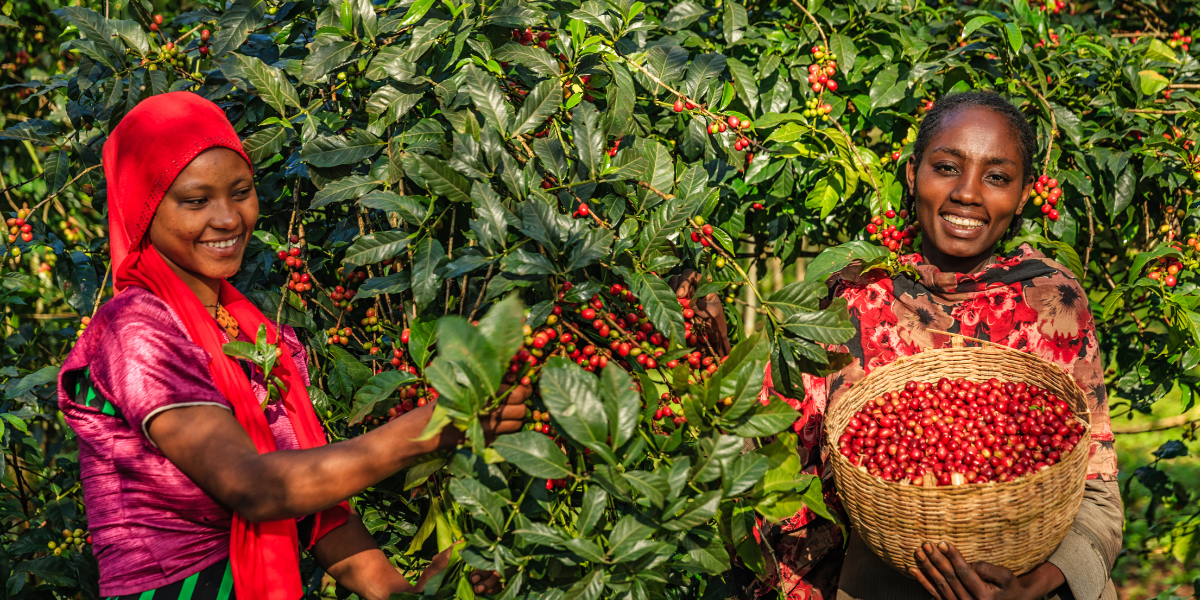
As these improvements take hold across production and processing, the focus naturally shifts to market connectivity. Becoming export-ready means much more than having a good product — it requires alignment with buyer standards, certifications, and the ability to meet demanding logistical and regulatory requirements. In practice, this involves not only farmers and processors but also governments, trade agencies, and development partners working together to raise competitiveness across entire value chains.
A TradeMark Africa program found that Kenyan flower and vegetable exporters lost 30% of EU sales due to compliance failures with European food-safety and traceability rules. To fix this, the program retrained over 750 farmer groups in GlobalGAP standards—an internationally recognized private sector certification ensuring good agricultural practices in food safety, environmental sustainability, and worker welfare—restoring market access and proving how structured support can directly translate into regained export revenues. This example shows how technical compliance and farmer capacity-building can determine success in premium markets. In Ghana, Blue Skies, a major fruit exporter, demonstrates how aligning with ethical and environmental certifications boosts brand value abroad. The company credits Fairtrade and organic certifications for helping it secure long-term contracts with European retailers — a model that links smallholder inclusion with global consumer demand for responsibly sourced products. Similarly, Nigerian sesame exporters have found that certifications and phytosanitary standards are not obstacles but opportunities. By meeting Japanese and European import requirements, they have gained access to premium markets and attracted investment in better processing and storage. These examples show that compliance, when leveraged strategically, can fuel growth rather than add cost. Beyond certification, trade frameworks like AfCFTA and AGOA are reshaping market access by lowering tariffs and simplifying customs, enabling African exporters to reach global buyers more easily. Coupled with stronger logistics networks and regional transport corridors, these agreements are making it faster and more efficient to move high-value perishables across Africa and beyond. Also, public-private collaboration is equally critical when external shocks threaten supply chains. During COVID-19, Kenya’s horticulture sector partnered with Kenya Airways and the Horticultural Crops Development Authority to keep exports moving to London markets despite global flight disruptions — an example of coordination built through collaboration.
A Smarter Transition & Future-Proofing Agribusiness
With strong foundations in place, the path forward is clearer yet still demanding: profitable and export-ready agribusiness in Sub-Saharan Africa now hinges on operational scale, robust legal and financial structures, and full value-chain integration. When investors, governments, and entrepreneurs partner effectively — as seen in models like Export Trading Group (ETG), Babban Gona, and Zambeef Products Plc — they transform agriculture into a growth engine for local economies, not simply a commodity play. Looking ahead, digital compliance systems, carbon-tracking, and traceability platforms are no longer optional add-ons — they are investor entry tickets. Agribusinesses that adopt technologies for transparency, sustainability, and resilience will unlock premium markets, secure impact-driven capital, and strengthen Africa’s position as a global food leader.